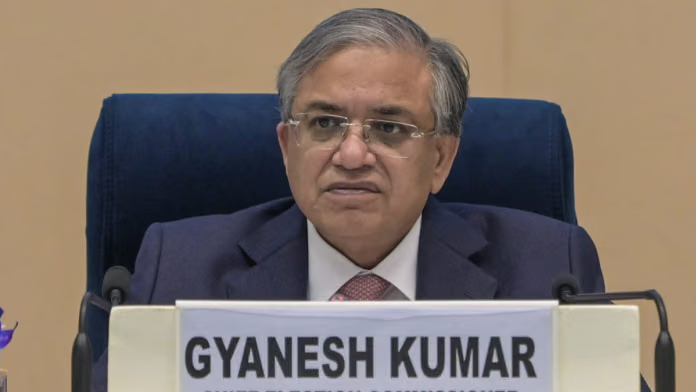
Gyanesh Kumar is the 26th Chief Election Commissioner of India, having assumed office on 19 February 2025. A retired Indian Administrative Service officer of the 1988 batch belonging to the Kerala cadre, he became the first CEC to be appointed under the Chief Election Commissioner and Other Election Commissioners (Appointment, Conditions of Service and Term of Office) Act, 2023. His career spans over three decades of service across state and central governments, including key roles in the Ministry of Home Affairs during the abrogation of Article 370 and the constitution of the Ram Janmabhoomi Teerth Kshetra Trust.
Quick Facts
| Field | Information |
|---|---|
| Full Name | Gyanesh Kumar |
| Date of Birth | 27 January 1964 |
| Place of Birth | Agra, Uttar Pradesh, India |
| Age (as of September 2026) | 62 years |
| Profession | Chief Election Commissioner of India (retired IAS officer) |
| Nationality | Indian |
| Batch | 1988, Indian Administrative Service |
| Cadre | Kerala |
| Education | B.Tech (Civil Engineering), IIT Kanpur; Business Finance, ICFAI; Environmental Economics, Harvard University |
| Spouse | Anuradha |
| Children | Two daughters (Medha Roopam, Abhisharpi) and one son (Arnav Kumar) |
| Known For | 26th CEC of India; role in Article 370 abrogation; Ram Janmabhoomi Trust |
| Term as CEC | Until 26 January 2029 |
| Predecessor | Rajiv Kumar |
Table of Contents
Who Is Gyanesh Kumar?
Gyanesh Kumar is a former IAS officer who served in both the Kerala state government and various central ministries before being appointed as an Election Commissioner in March 2024. Less than a year later, he was elevated to the position of Chief Election Commissioner. He is an engineer by training, having graduated from IIT Kanpur, and has also studied at Harvard University. His tenure as CEC will continue until January 2029, covering several major state assembly elections and the next general election cycle.
Early Life and Family Background
Gyanesh Kumar was born on 27 January 1964 in Agra, Uttar Pradesh. His father, Dr. Subodh Kumar Gupta, retired as a Chief Medical Officer/Superintendent, and his mother, Satyawati Gupta, is known in her local community for her knowledge of the Bhagavad Gita and yoga. The family has its roots in Midhakur, a town on the Agra-Jaipur highway, before moving to Agra city.
His family is notably accomplished. According to multiple reports, his extended family includes approximately 28 doctors, and several members have pursued careers in the civil services. His younger brother, Manish Kumar, is an IRS officer, and his sister, Roli, runs a school in Indore.
Education
Gyanesh Kumar completed his schooling in Gorakhpur, Lucknow, and Kanpur. He was a topper in both his Class 10 and Class 12 examinations conducted by the Board of High School and Intermediate Education, Uttar Pradesh, studying at Colvin Taluqdar’s College in Lucknow. He then cleared the JEE examinations and pursued a B.Tech in Civil Engineering from IIT Kanpur.
After graduation, he briefly worked at HUDCO in Delhi for about a year before clearing the IAS examination in 1988. He later studied Business Finance at ICFAI, India, and completed a course in Environmental Economics at Harvard University, USA.
Career as an IAS Officer
Early Career in Kerala
Gyanesh Kumar began his administrative career in 1988 as a Sub-Collector in Pathanamthitta, Kerala. Over the years, he held several key positions in the Kerala state government, including District Collector of Ernakulam, Municipal Commissioner of Cochin Corporation, and Managing Director of the Kerala State Development Corporation for SC/ST. He also headed departments such as Finance Resources, Public Works, and Food, Civil Supplies & Consumer Affairs.
He served in Kerala under both Left and Congress-led governments, which observers have noted as a testament to his professional standing across political lines. In 2012, he was appointed Resident Commissioner at Kerala House in Delhi.
Central Government Roles
Gyanesh Kumar’s central government career includes several significant positions:
- Joint Secretary, Ministry of Defence (2007–2012): He served as Joint Secretary (Defence Production) during the UPA government. During this period, he also played a role in the evacuation of 183 Indians, including 83 Malayali nurses, stranded in Iraq during the ISIS crisis.
- Joint Secretary/Additional Secretary, Ministry of Home Affairs (2016–2021): In May 2016, he was appointed Joint Secretary in the Kashmir Division of the Home Ministry. In 2019, after Amit Shah became Home Minister, Kumar was involved in drafting the Jammu and Kashmir Reorganisation Bill, which led to the abrogation of Article 370 and the division of the erstwhile state into two Union Territories. He also played a key role in constituting the Shri Ram Janmabhoomi Teerth Kshetra Trust, which oversaw the construction of the Ram temple in Ayodhya.
- Secretary, Ministry of Parliamentary Affairs (2021–2022): He served as Parliamentary Affairs Secretary from May 2021 to May 2022.
- Secretary, Ministry of Cooperation (2022–2024): He was appointed as the first Secretary of the newly created Ministry of Cooperation under Amit Shah, serving from May 2022 until his retirement on 31 January 2024. During his tenure, the Ministry saw the enactment of the Multi-State Cooperative Societies (Amendment) Act, 2023, the formation of three new national cooperative bodies, and the launch of the CRCS-Sahara refund portal.
Appointment as Election Commissioner
Less than two months after his retirement from government service, Gyanesh Kumar was appointed as an Election Commissioner. His appointment was announced on 14 March 2024, and he assumed charge on 15 March 2024, joining the Election Commission alongside Sukhbir Singh Sandhu. During his tenure as Election Commissioner, elections were held for the 18th Lok Sabha and the State/UT Assemblies of Jammu and Kashmir, Haryana, Maharashtra, Jharkhand, and NCT of Delhi.
Appointment as Chief Election Commissioner
Gyanesh Kumar was appointed as the 26th Chief Election Commissioner on 17 February 2025 by a three-member selection panel headed by Prime Minister Narendra Modi, which also included Union Home Minister Amit Shah and Leader of Opposition Rahul Gandhi. He assumed charge on 19 February 2025, succeeding Rajiv Kumar.
His appointment was notable for being the first under the new law, the Chief Election Commissioner and Other Election Commissioners (Appointment, Conditions of Service and Term of Office) Act, 2023. This law replaced the Chief Justice of India with a Union Minister in the selection panel, giving a more dominant role to the Central government in the appointment process.
After assuming charge, Kumar stated: “First step for nation building is voting. Therefore, every citizen of India who has completed 18 years of age should become an elector and should always vote. Election Commission was, is and will always be with the voters”.
His term as CEC will run until 26 January 2029, during which he is expected to oversee the Bihar Assembly elections, Assembly polls in Kerala, Puducherry, Tamil Nadu, and West Bengal in 2026, and the elections for President and Vice-President in 2027.
Personal Life and Family
Gyanesh Kumar is married to Anuradha. His family has a strong presence in India’s administrative and medical fields:
- Daughter Medha Roopam: A 2014-batch Uttar Pradesh cadre IAS officer, she has served as District Magistrate of Kasganj and Noida. She is married to Manish Bansal, an IAS officer who has served as District Magistrate of Agra.
- Daughter Abhisharpi: An IRS officer, married to Akshay Labroo, an IAS officer.
- Son Arnav Kumar: Pursuing his studies.
A neighbour in Agra described Kumar as “very focused” and someone who “loves to go into minute details of whatever he pursues”. He is also known to have a fondness for the Ramayana.
Controversies and Public Discourse
Gyanesh Kumar’s tenure as CEC has coincided with significant public and political debate. In 2026, the Election Commission faced controversy over the Special Intensive Revision (SIR) of electoral rolls. An Indian Express investigation reported that Election Commissioners Sukhbir Singh Sandhu and Vivek Joshi had formally objected at least 14 times over decisions they said were taken without their knowledge. Opposition parties, including the Congress, alleged that Kumar used the poll panel to favour the ruling party; Kumar has rejected the allegation.
A purported resignation letter attributed to Kumar was circulated on social media in September 2026. The Election Commission termed the letter “fake” and issued a statement asserting that all SIR-related orders were issued after approval from all three election commissioners.
Separately, former Kerala Chief Secretary Jiji Thomson alleged that Kumar, while serving as an IAS officer in 2016, asked him whether he was interested in contesting the 2019 Lok Sabha election as a BJP candidate from Pathanamthitta. Kumar has not publicly responded to these allegations. These remain attributed allegations rather than established facts.
Timeline
| Year | Event |
|---|---|
| 1964 | Born on 27 January in Agra, Uttar Pradesh |
| 1988 | Cleared IAS examination; allotted Kerala cadre |
| 1990 | Began career as Sub-Collector, Pathanamthitta |
| 2007–2012 | Joint Secretary (Defence Production), Ministry of Defence |
| 2016 | Appointed Joint Secretary, Kashmir Division, Ministry of Home Affairs |
| 2019 | Involved in drafting Jammu and Kashmir Reorganisation Bill; Article 370 abrogation |
| 2020 | Involved in constituting Ram Janmabhoomi Teerth Kshetra Trust |
| 2021–2022 | Secretary, Ministry of Parliamentary Affairs |
| 2022–2024 | Secretary, Ministry of Cooperation |
| 31 Jan 2024 | Retired from government service |
| 14 Mar 2024 | Appointed Election Commissioner |
| 15 Mar 2024 | Assumed charge as Election Commissioner |
| 17 Feb 2025 | Appointed Chief Election Commissioner |
| 19 Feb 2025 | Assumed charge as 26th CEC of India |
FAQs
1. Who is Gyanesh Kumar?
Gyanesh Kumar is the 26th Chief Election Commissioner of India. He is a retired 1988-batch IAS officer of the Kerala cadre who previously served as Election Commissioner and held senior positions in the Ministry of Home Affairs, Ministry of Defence, and Ministry of Cooperation.
2. How old is Gyanesh Kumar?
Gyanesh Kumar was born on 27 January 1964. As of September 2026, he is 62 years old.
3. Where was Gyanesh Kumar born?
He was born in Agra, Uttar Pradesh, India.
4. What is Gyanesh Kumar’s educational background?
He holds a B.Tech in Civil Engineering from IIT Kanpur. He also studied Business Finance at ICFAI, India, and Environmental Economics at Harvard University, USA.
5. When did Gyanesh Kumar become Chief Election Commissioner?
He assumed charge as the 26th CEC of India on 19 February 2025.
6. What was Gyanesh Kumar’s role in the Article 370 abrogation?
As Additional Secretary in the Ministry of Home Affairs, Kumar was involved in drafting the Jammu and Kashmir Reorganisation Bill, which led to the abrogation of Article 370 in 2019.
7. Is Gyanesh Kumar married?
Yes, he is married to Anuradha.
8. Who are Gyanesh Kumar’s children?
He has two daughters, Medha Roopam (IAS officer) and Abhisharpi (IRS officer), and a son, Arnav Kumar.
9. What is Gyanesh Kumar’s term as CEC?
His term as Chief Election Commissioner is valid until 26 January 2029.
10. What key elections will Gyanesh Kumar oversee as CEC?
His tenure covers the Bihar Assembly elections, Assembly polls in Kerala, Puducherry, Tamil Nadu, and West Bengal in 2026, and the Presidential and Vice-Presidential elections in 2027.
11. Was Gyanesh Kumar the first CEC appointed under the new 2023 law?
Yes, he is the first CEC to be appointed under the Chief Election Commissioner and Other Election Commissioners (Appointment, Conditions of Service and Term of Office) Act, 2023.
12. What positions did Gyanesh Kumar hold in the Kerala government?
He served as District Collector of Ernakulam, Municipal Commissioner of Cochin Corporation, and headed departments including Finance Resources, Public Works, and Food & Civil Supplies.
13. What is Gyanesh Kumar’s connection to the Ram Janmabhoomi Trust?
He played a key role in constituting the Shri Ram Janmabhoomi Teerth Kshetra Trust while serving in the Ministry of Home Affairs.
14. Did Gyanesh Kumar face any controversies as CEC?
His tenure has seen public debate over the Special Intensive Revision (SIR) of electoral rolls and allegations from opposition parties regarding the poll panel’s functioning, which he has rejected.
15. What did Gyanesh Kumar say after becoming CEC?
He stated that the first step for nation building is voting and that the Election Commission “was, is and will always be with the voters.”
16. How many doctors are in Gyanesh Kumar’s family?
According to multiple reports, his extended family includes approximately 28 doctors.
17. What is Gyanesh Kumar’s IAS batch and cadre?
He is a 1988-batch IAS officer belonging to the Kerala cadre.
18. Did Gyanesh Kumar work in the Ministry of Defence?
Yes, he served as Joint Secretary (Defence Production) in the Ministry of Defence from 2007 to 2012.
19. What is Gyanesh Kumar known for professionally?
He is known for his extensive administrative career across state and central governments, his involvement in major policy decisions including Article 370 abrogation, and his current role as India’s Chief Election Commissioner.
20. Where does Gyanesh Kumar’s family live?
His parents reside in Agra’s Vijay Nagar colony. His extended family is spread across various locations in India.
More Info About Famousbiographys